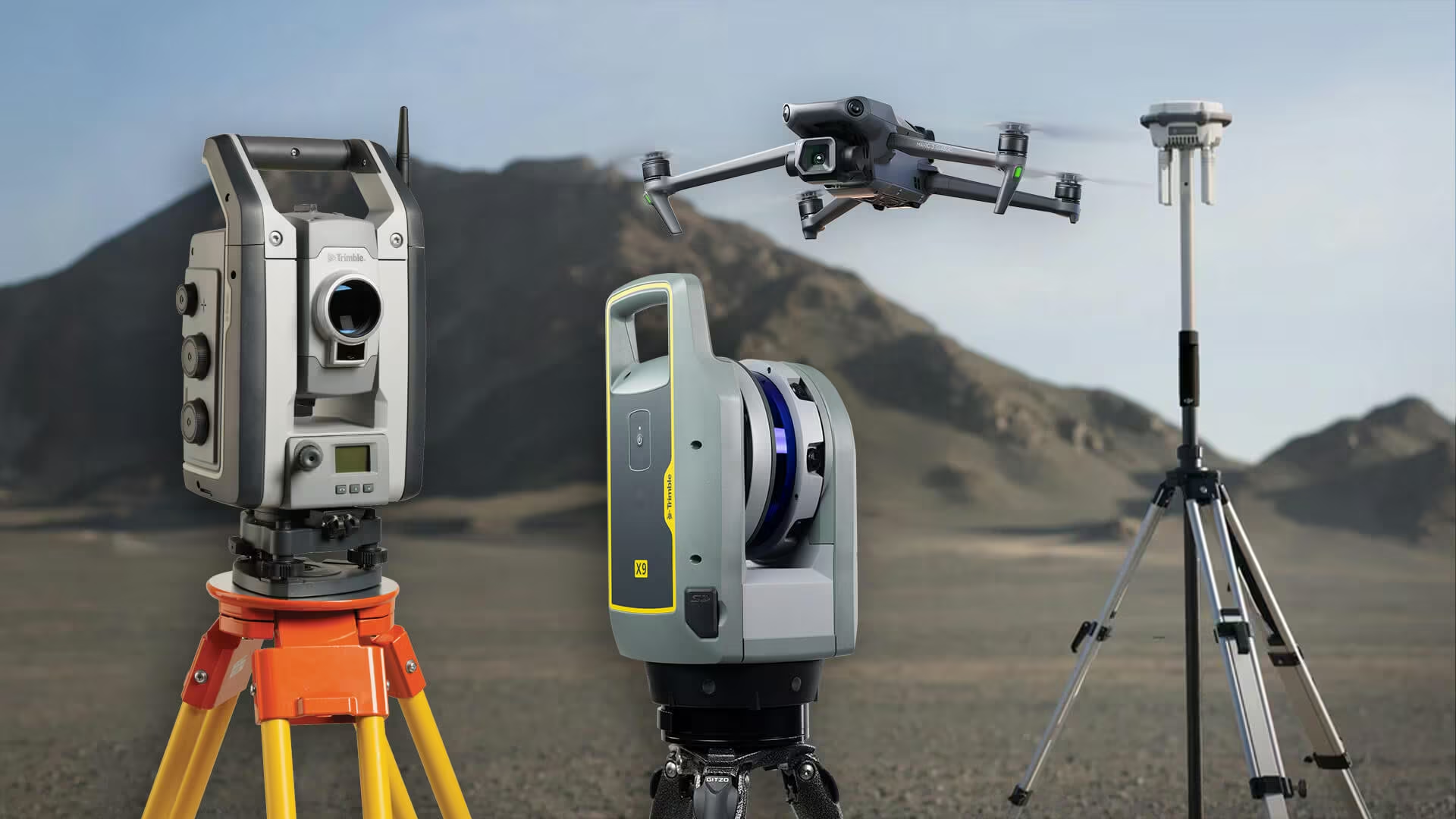
The Main Types of Survey Equipment Used in Modern Land and Construction Projects
Contact OPTRON to find out more about our Survey Equipment solutions!
Imagine mapping an entire site in minutes, generating precise 3D models on the same day and keeping your team out of hazardous terrain – that’s the new standard achievable with a modern drone survey.
Across South Africa, industries such as construction, mining, agriculture and land development rely on fast, accurate geospatial data to keep projects moving. With an aerial mapping drone, teams capture rich, consistent spatial data far faster and with greater coverage than traditional ground-based methods.
As a leading provider of unmanned aerial vehicles (UAVs) and geospatial technology in Southern Africa, OPTRON supplies surveyors with DJI Enterprise drone platforms, sensors and processing tools that enable this level of accuracy and efficiency in real-world field conditions.
With this foundation in place, it’s helpful to understand precisely how drone land surveying works and why these technologies deliver such reliable results in the field.
Quick Summary
-
Modern surveying equipment includes total stations, GNSS receivers, 3D laser scanners and drones.
-
Each survey instrument offers different levels of accuracy and efficiency depending on the project.
-
Total stations and GNSS systems are the most widely used tools for construction layout and land surveys.
-
3D scanners and drones capture large or complex sites quickly with high detail.
-
Choosing the right equipment depends on accuracy needs, site conditions and project scale.
Surveying Equipment at a Glance
| Surveying Equipment | Primary Use | Accuracy | Best For |
|---|---|---|---|
| Total Station | Angle and distance measurement | Very high | Construction layout, boundary marking |
| GNSS Survey Instrument | Positioning over large areas | High to very high | Topographic surveys, infrastructure planning |
| 3D Laser Scanner | Full site capture in 3D | Exceptional | As built documentation, BIM, plant layout |
| Drone Survey Equipment | Large area imaging | High | Mining, agriculture, terrain modelling |
Why Understanding Survey Equipment Matters
Choosing the right equipment for surveyors isn’t just about staying up to date with the latest tech. It’s about ensuring that your data is accurate, repeatable and efficient to collect. The right tool can help you:
-
Improve project timelines
-
Reduce human error
-
Boost productivity in the field
-
Ensure compliance with local regulations
-
Save money on rework
With a variety of options available, each suited to different applications, it’s worth understanding how these tools differ and where they shine. From traditional instruments to cutting-edge digital systems, here’s a closer look at the most widely used types of survey equipment today:
1. Total Stations
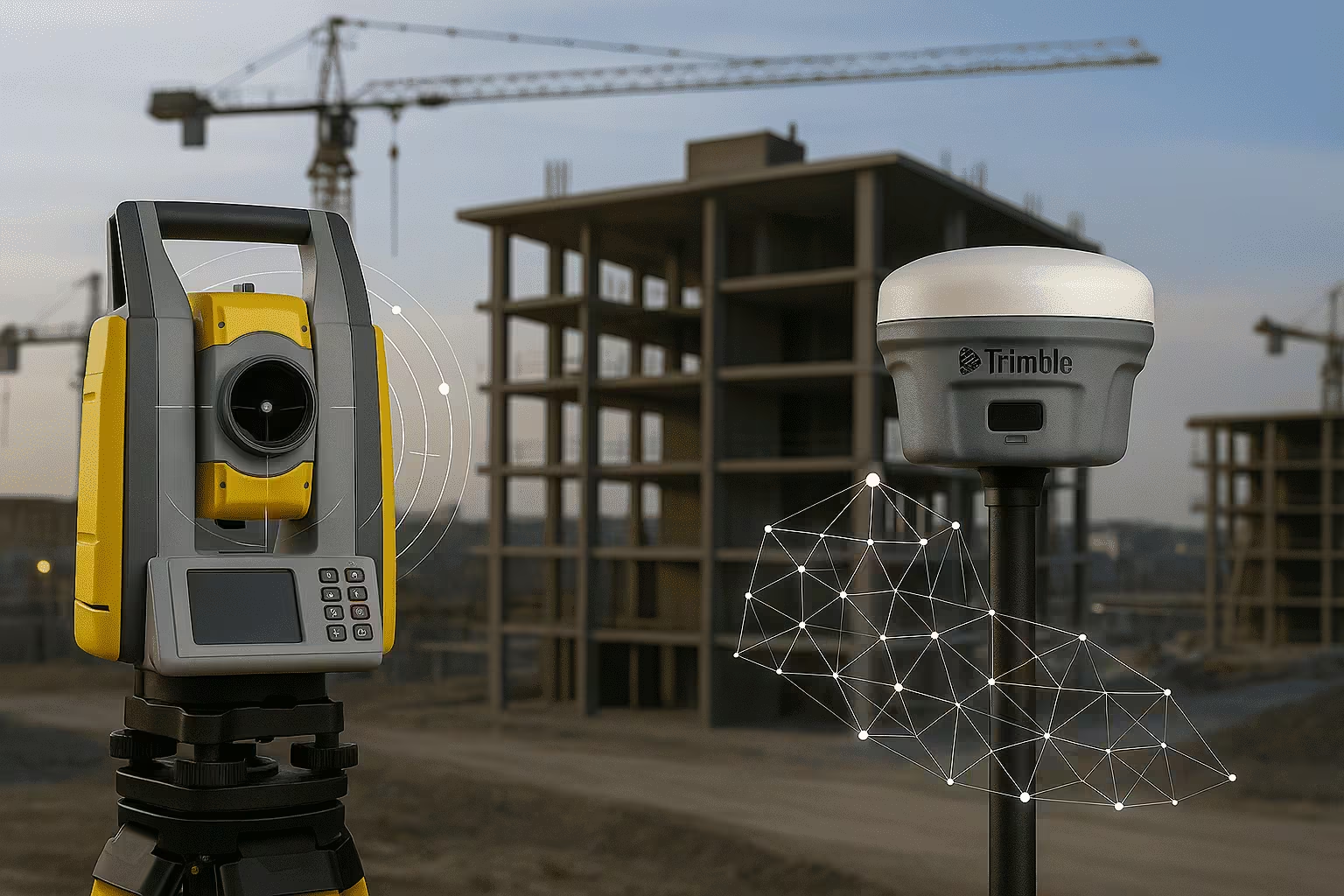
A total station is a versatile and highly accurate piece of survey equipment used to measure both angles and distances with precision. It combines traditional optical surveying methods with modern electronic measurement and data processing, making it a powerful tool for a wide range of applications – from boundary marking and topographic mapping to infrastructure development and engineering layout.
Modern systems, like those from Trimble, go beyond basic functionality. They feature robotic control, automated target tracking and seamless integration with data management software, which allows for smoother workflows between field and office. Whether you’re working on a small land parcel or a complex construction site, total stations are designed to help surveyors collect precise data quickly and efficiently.
What makes these systems especially valuable is their ability to scale with the demands of your project. With both manual and robotic models available, as well as options with integrated scanning capabilities, total stations can adapt as your needs evolve. For professionals who value speed, reliability and long-term performance, they remain one of the most essential tools in the field.
Who should use this survey instrument
Total stations suit land surveyors, construction teams and engineering professionals who need high accuracy measurements, fast layout and smooth integration with CAD or GIS systems.
Applications:
-
Topographical surveys
-
Construction layout
-
Monitoring structural movement
-
Utility mapping or subsurface utility information
Benefits:
-
High accuracy
-
Fast setup
-
Easy data transfer to CAD/GIS software
Many professionals opt for robotic total stations, which allow a single operator to control the instrument remotely – boosting productivity even further.
2. GNSS/GPS Survey Equipment
GNSS (Global Navigation Satellite System) survey equipment – often referred to as GPS -is essential for modern land development and infrastructure projects. Unlike consumer-grade GPS devices, professional GNSS systems used in surveying provide millimetre-level precision by leveraging satellite signals from multiple constellations to achieve highly accurate positioning.
These systems are ideal for applications such as large-scale topographic surveys, road and rail alignment, boundary marking and construction progress tracking. Key benefits include exceptional accuracy in open areas, real-time positioning capabilities (RTK) and suitability for wide-area surveys.
OPTRON offers a comprehensive range of GNSS surveying equipment designed for varying surveying needs, from basic mapping tasks to advanced geodetic measurements, helping professionals better understand the Earth’s geometry and gravitational forces to determine accurate positions and elevations across large distances.
When GNSS surveying equipment is the best choice
GNSS receivers are ideal for wide area mapping, road design, boundary marking and any project that needs high accuracy positioning in open environments.
3. 3D Laser Scanners
3D laser scanners are transforming how spatial data is captured, enabling surveyors to collect millions of measurement points per second. The result is highly accurate point clouds that represent real-world environments in exceptional detail.
Why laser scanning is becoming essential surveying equipment
Laser scanners provide detailed point clouds that improve design, verification and site documentation. This survey machine captures complex areas quickly and without physical contact.
Applications:
-
As-built documentation to verify how a project was constructed
-
Heritage site preservation
-
BIM (Building Information Modelling) workflows for improved project outcomes
-
Plant design and construction planning
Benefits:
-
Fast, non-contact data capture
-
High-resolution output
-
Ideal for complex geometries and difficult-to-access areas
Though these scanners represent a higher upfront investment, the value they provide for large-scale or intricate projects makes them a powerful tool in any surveyor’s workflow.
4. Drones and Aerial Survey Equipment
Drones, also known as unmanned aerial vehicles (UAVs), have quickly become a valuable tool in modern surveying. Equipped with high-resolution cameras and, in some cases, LiDAR sensors, drones enable surveyors to capture data across vast areas quickly and efficiently.
Who benefits most from aerial surveying equipment
Drone surveys are perfect for mining, construction progress tracking, agriculture, disaster planning and any project that needs fast high volume site data.
Applications:
-
Agriculture and forestry
-
Open-pit mining
-
Flood risk assessment
-
Construction progress monitoring
Benefits:
-
Fast, high-volume data collection
-
Aerial viewpoints that improve site understanding
-
Less time needed on-site
When paired with powerful software like Trimble Stratus or Trimble Business Center, drone data can be transformed into orthomosaics, digital elevation models and volumetric measurements. DJI drones, in particular, integrate seamlessly with Trimble Business Center – making it easy to import imagery and video for advanced processing and analysis. This streamlined workflow helps teams move from data capture to actionable insights faster and more accurately.
5. Mobile Mapping Systems
Mobile mapping integrates GNSS, inertial measurement units (IMUs) and laser scanning technology into a moving vehicle. It’s a high-end solution often used by governments and infrastructure developers.
When to use mobile surveying instruments
Mobile mapping is best for long transport corridors, road and rail inventories and large infrastructure networks that require continuous and safe data capture.
Applications:
-
Road and rail asset inventory, utility corridor mapping and smart city development are all ideal use cases for this solution.
Benefits:
-
It enables fast, continuous data collection, making it especially suitable for long, linear projects while minimising on-site disruption.
While not suitable for every project, mobile mapping systems are indispensable when speed, coverage and safety are priorities.
Common Types of Surveying Instruments and Tools
Survey professionals rely on a variety of surveying equipment to complete different field tasks. These tools include traditional optical instruments, digital survey machines, GNSS receivers, laser scanners, drones and measuring materials used in daily operations. Together, these surveying tools help create accurate maps, layouts and 3D site models.
Examples of commonly used land survey equipment
-
Total stations for angle and distance measurement
-
GNSS survey instruments for high accuracy positioning
-
3D laser scanners for full site capture
-
Drones for aerial data collection
-
Measuring tools and survey materials such as rods, tripods, prisms and targets
Choosing the Right Tools for the Job
Selecting the right types of survey equipment depends on several factors:
-
Project size and scope – Is it a small plot or a national highway?
-
Accuracy requirements – Are you doing a general boundary check or detailed construction layout?
-
Environment – Urban environments can interfere with GNSS, while scanners may struggle in rain or fog.
-
Budget – Some advanced tools come with a hefty price tag but offer a fast ROI.
-
Skill level – Consider who will operate the surveying equipment and how much training is needed.
Working with a trusted partner like OPTRON can help ensure you match the right tool to the job every time.
What Makes OPTRON Survey Equipment Different?
OPTRON partners with Trimble and DJI Enterprise to bring global-grade survey instruments to Southern Africa. Whether you’re a civil engineer, construction manager, or professional land surveyor, OPTRON provides:
-
-
Product training and certification
-
Calibration and maintenance services
-
The latest technology backed by a global brand

Our range includes everything from GNSS receivers to 3D scanners and robotic total stations – all carefully selected to meet the demands of today’s professionals.
Equip Yourself for Success
Understanding the different types of survey equipment empowers you to make smarter choices – whether you’re improving workflows, reducing errors, or tackling more complex projects. From GNSS systems and total stations to 3D scanners and drones, the right tools can transform how you measure the world.
If you’re looking for guidance, OPTRON’s expert team is here to help you choose the best fit for your next project.
*BVLOS permissions: Allowing drone operators to fly beyond visual line of sight.